

Industry News
Best Jewelry Cotton Buffing Wheels for a Mirror Finish
Every bench jeweler knows the frustration: you’ve spent hours filing, sanding, and prepping a piece of custom gold or platinum jewelry, only to have the final polish leave behind a hazy, cloudy surface or microscopic hairline scratches. Achieving a true, flaw-free mirror finish isn’t just about the polishing compound you use; it is heavily dictated by the quality, material, and structure of your polishing wheel.

Final-stage polishing is a delicate balancing act of friction, heat, and pressure. Because this is the absolute last step before a piece goes into the ultrasonic cleaner and into the showroom, it requires a completely scratch-free result.
Many high-volume shops mistakenly rely on wool wheels or sisal buffs for final finishing, but these materials are structurally too aggressive for fine jewelry applications:


Quick Selection Guide: Top Cotton Buffs at a Glance
If you want to deliver that breathtaking, high-carat reflection that catches the light flawlessly, you need the right tool for the job. Here is a quick breakdown of the top-performing cotton buffing wheels engineered for specific workshop scenarios:- Best Overall: Premium Loose Flannel Wheel
The definitive top choice for an ultimate, ultra-glossy mirror finish. - Best for Edges & Details: Stitched Muslin Buff
Expertly balances minor cutting power with pristine surface smoothing without rounding crisp edges. - Best for Small Parts: Mounted Cotton Miniature Buffs
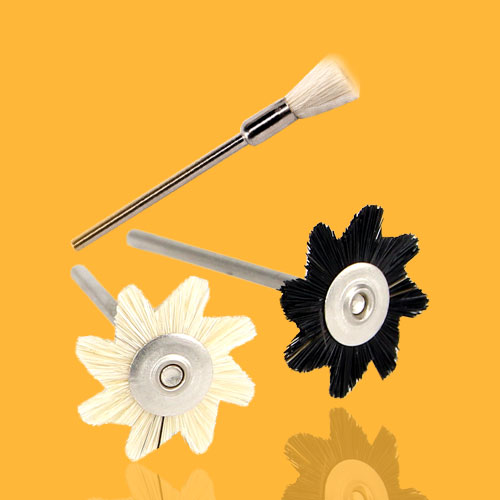
Engineered specifically for intricate jewelry, pendant drills, flex shafts, and high-speed micromotors.
I.Why Cotton and Flannel are the Non-Negotiable Choice for a Mirror Finish

Final-stage polishing is a delicate balancing act of friction, heat, and pressure. Because this is the absolute last step before a piece goes into the ultrasonic cleaner and into the showroom, it requires a completely scratch-free result.
Many high-volume shops mistakenly rely on wool wheels or sisal buffs for final finishing, but these materials are structurally too aggressive for fine jewelry applications:
- Wool wheels possess coarse, inconsistent fibers that tend to leave tiny thread marks or a "hazy" pattern on softer precious metals like 24K gold or sterling silver.
- Sisal wheels exhibit excessive cutting power, which can accidentally round off sharp, intentional geometry or erase delicate filigree work.
II. Detailed Reviews of the 4 Best Jewelry Cotton Buffing Wheels
1. Premium Fine Flannel Wheel

- Features: Extremely soft, combed cotton face with an unstitched, loose construction.
- Why it made the list: This is the undisputed champion for the final stage of jewelry finishing. Because it lacks rigid stitching, the layers of fine flannel flare out smoothly under centrifugal force, allowing the wheel to conform seamlessly to domed surfaces, large lockets, and broad silver cuffs. It guarantees absolutely no physical scratches or directional drag lines, delivering an incredibly deep, high-clarity luster on gold, platinum, and high-end silver pieces.
2. Concentric Stitched White Muslin Buff

- Features: Tight, concentric rows of heavy-duty stitching that provide slight rigidity and enhanced compounding power.
- Why it made the list: A mirror finish cannot always be achieved in a single pass from a sanded surface. This stitched pure cotton wheel is the ultimate choice for the "pre-polishing" stage before you transition to a loose flannel wheel. The stitched rows keep the cotton plies compact, giving you the mild cutting action needed to erase minor fire-scale or lingering pre-polish marks. It is particularly indispensable for flat surfaces—such as the outer bands of signet rings or geometric pendants—where maintaining crisp, sharp edges is critical.
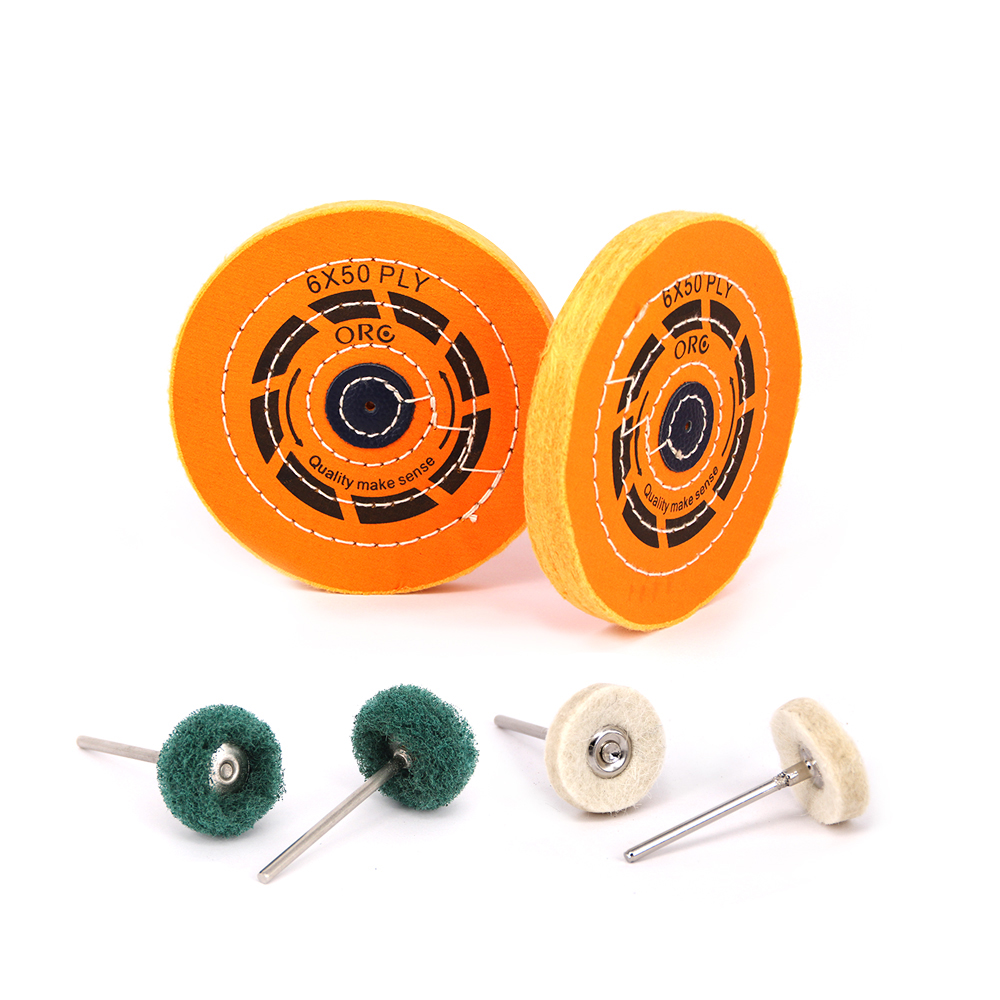
3. Mounted Cotton Miniature End Buffs

- Features: Small diameter configurations (typically 1/4" to 1") securely mounted on integrated 2.35mm (3/32") or 3mm steel shanks.
- Why it’s a top pick: Large bench lathes are useless when dealing with intricate, complex jewelry designs. These miniature cotton buffing wheels are engineered specifically for jewelry pendant drills, flex shafts, and laboratory-grade micromotors. They are the premier solution for driving high-end compounds directly into hard-to-reach areas like prong settings, the dense honeycomb matrices of micro-pavé bases, and the inner walls of ring bands.
4. Untreated Yellow/Unbleached Cotton Buff

- Features: 100% natural, unbleached, eco-friendly organic cotton fibers free from harsh chemical treatments.
- Why it’s a top pick: Certain metals—most notably 925 sterling silver and lower-karat copper alloys—are highly prone to heat sensitivity, chemical staining, and surface discoloration during high-speed buffing. Unbleached cotton buffs provide an exceptionally gentle thermal transition, keeping friction heat to a minimum while ensuring no chemical residues from bleached fibers react with the metal.
III. Buying Guide: How to Choose the Right One for Your Workshop
To optimize your polishing station and avoid costly trial and error, look beyond the price tag and select your buffs based on these three workflow-driven criteria:1. Match the Ply Count to Your Production Volume
When choosing the thickness of your wheel, always check the ply count (the number of individual fabric layers). While 30-ply or 40-ply wheels are common for light hobby work, professional jewelry workshops should invest in 50-ply or 60-ply configurations. A higher ply count delivers a thicker, denser buff that maintains its shape under lateral pressure, holds compound more efficiently, and provides the durability required for continuous industrial use without premature collapsing.2. Select the Right Arbor Hole Material for Spindle Stability
To prevent dangerous wheel wobble and chatter marks on your metal, the core of the buff must align perfectly with your machinery. For heavy-duty bench lathes, choose a wheel with a Lead Center insert over standard plastic or leather centers. Tapered lead centers grip the threaded spindle tightly without stripping, ensuring the buff spins perfectly true at high speeds and extending the operational lifespan of the wheel's core.3. Inspect Stitch Density to Control Fraying and Workshop Dust
High-speed buffing—running up to 3,400 RPM on lathes or 15,000 RPM on micromotors—creates immense centrifugal force. To prevent your wheels from immediately unravelling and filling your dust collection hoods with loose threads, choose buffs built with premium anti-fraying double-stitching. High stitch density ensures that the cotton face wears down evenly, keeping your workspace cleaner and your finishing precise.IV. B2B / Wholesale Section: Sourcing Direct from the Manufacturer
For global distributors, jewelry tool brands, and high-volume manufacturing facilities, consistency in consumable supply chains is vital. Orobrush is a premier original manufacturer of high-grade jewelry surface finishing consumables, producing premium cotton buffs built to withstand rigorous industrial use.- Factory-Direct Advantages: By eliminating intermediate trading companies, Orobrush offers highly competitive wholesale pricing on bulk orders, directly improving your bottom line.
- OEM/ODM Customization: We tailor our manufacturing to your exact brand specifications. Distributors can customize stitch density, specify exact ply counts, order diameters ranging from 1" miniature buffs up to 8" industrial lathe wheels, and even request private label branding via precise laser marking on the fabric surface.